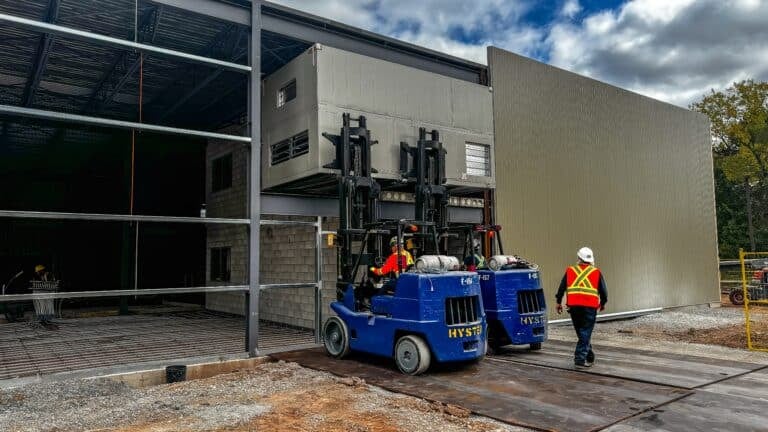
Complex relocations can be very difficult, especially when multiple facilities are involved. That’s why it’s inherently important to take your time, study everything you can, and just push the boundaries of everything that you might expect. With that in mind, using floating services can be a great idea, as you can use landoll tilt trucks and special float trucks for efficient moving. It’s ideal for transporting machines and materials to/from any construction site.
Why are multi-facility equipment relocations very complex?
There are many challenges that come from multi-facility relocations. For example, the complex equipment needs to be decommissioned at the first facility without any extra operations, the transport must be synced with access windows, you also need to have regulatory approvals, along with installation readiness at each facility involved, all while matching delivery timings. These are all very challenging to do, and you can also add the need for specialized transport modes where possible, which can be inherently problematic.
How can a complex equipment float service help?
The role of a complex equipment float service is to help move heavy, oversized machinery using low-deck trailers, also called floats. These make it easy for the equipment to just drive it on the transport platform, or in some cases, you can winch it on. It’s an excellent solution for transporting across multiple facilities, and it also helps bypass the need for cranes.
Additionally, the system is excellent because it can handle loads well beyond standard trucks. It’s an excellent solution for manufacturing, agriculture, construction, and other industries. Thanks to float services, it becomes much easier to maintain compliance and transport items that are beyond the legal width or height limit. You still need a permit and legal compliance, but it becomes much easier to move stuff like graders, excavators, or bulldozers this way.
Generally, a float service will use specialized trailers, mainly removable gooseneck trailers, dropdecks or lowboys. These transport systems can be used for anything from a forklift to large, industrial machines. Some of the benefits include:
- You have a system that’s faster than cranes, and you get less downtime for complex equipment.
- Logistics are much easier, since you can manage route planning and complex paperwork a lot faster.
- Plus, there is a safety benefit, since you can reduce the risk of accidents or injuries, which are prevalent during the unloading and loading process.
Creating a centralized relocation structure
Maybe the best thing that you need to do here is to appoint a relocation program lead. He will be able to schedule integration, handle budgets, perform risk escalation, while also doing any decision-making across multiple site boundaries. That’s important, and it will help a whole lot more than you might expect.
Aside from this, it also makes sense to create a cross-facility steering committee. You want to have representatives from operations, maintenance, engineering, HSE, transport, and logistics, but also external contractors. The committee will ensure that everything is aligned and that you don’t need to worry about any concerns or problems that could potentially arise.
Asset mapping and professional dependency analysis
You should always document the dimensions, center of gravity, weight, operational criticality, redundancy, shutdown and restart requirements, along with sensitivity to vibration or tilt for each one of your assets. The info will determine if you need floating services or specialized handling. You can never be too careful when it comes to safety, so this particular approach is crucial, and it matters a whole lot more than expected.
At the same time, the inter-facility dependencies will matter a whole lot. That’s because many of the complex equipment relocations are independent, shared utilities or control systems will need to bypass solutions at least temporarily because of that. And in the case of automation and IT systems, you might need to do a phased migration.
Strategic phasing and scheduling
Coordination requires good scheduling, as that will help alleviate any concerns and focus on the best possible outcome. You should have an integrated master schedule made, which includes stuff like transport milestones, decommissioning windows, intermediate storage or special staging points, commissioning activities, and installation, along with many others. You want to avoid the isolated site schedules, and ideally, all the timelines should be rolling up in a single plan, linked with logic.
Phasing the relocation process is a very good idea. You want to move the redundant and non-critical equipment first, then the core process assets, and lastly, you want to move the auxiliary and supporting systems. Phasing makes it much easier to ensure everything is moved appropriately, and you will find that everything is working effectively. Plus, if there are any problems, you can learn from those mistakes on the go.
Transport strategy to cover multiple facilities
This is where things tend to become a lot more challenging. That’s because you will need to deal with multiple facilities, which adds its own extra set of challenges and problems that you potentially have to deal with. Here, you have to think of mode selection: are you going to deal with road transport via floating services, or even railroad transportation? These are all useful, but it comes down to the situation. Road transport is flexible, but urban areas and axle limits might bring in certain challenges. Rail transport is limited by siding access and specific loading geometry.
Floating services, however, are great for the oversized, indivisible loads, since you can easily load and unload them onto the transport vehicle without concerns. When you have complex equipment pieces like excavators, Bridge panels, or any heavy machinery, having a quick loading and unloading system is extremely useful. Adding these floating services to the relocation plan is a great idea, but you will need to have quite a bit of coordination, since you need to sync availability for both the destination and origin facilities.
Handling and engineering consistency across sites
It’s a major issue because if you don’t have adequate handling that stays consistent across sites, that’s going to be a problem. That’s why you need to have standardized engineering documentation, with approved documents for rigging and lifting, load securement, transport cradles and frames, but also temporary supports. All the documents will be valid across all the transport modes and facilities, which will also include floating services.
Of course, it does help if you minimize any re-handling, where possible. You want to get design transport frames that work on any of the transportation methods that you plan on using. Additionally, using the roll-on and roll-off techniques is a much better idea instead of the lift-on and lift-off. Plus, it helps if you keep the same complex equipment orientation for the move.
Compliance and regulatory coordination
Naturally, when we talk about multi-facility moves, you do need to ensure that you maintain regulatory compliance as much as possible. Harmonizing the compliance requirements can be challenging, but you do want to ensure everything goes as smoothly as possible. You want to have oversized load permits, environmental controls, labor and union rules, along with many other things. It also helps if you have a compliance coordination expert who will help track and harmonize the requirements across the entire relocation process.
Communication flow
Having the best possible communication might not seem like a whole lot, but it certainly makes a huge difference here. Ideally, you want to have a centralized digital platform that helps you with the engineering drawings, schedules, risk registers, contact lists, permit documentation, and so on. Having all of that stuff in a single place is going to help a ton, since it streamlines communication.
Daily coordination during execution is a great idea because you want to hold necessary coordination calls, review the completed tasks, risks, and any upcoming milestones. Moreover, it makes sense to review the readiness aspect while also making sure that you tackle time mismatches. It’s still a very good option to think about, especially from a professional standpoint, as it will make things much better than expected.
Risk management tasks to handle across multiple facilities
There are all kinds of tasks that you need to keep in mind here. For example, you want to avoid schedule misalignment between facilities, but also weather disruptions that can affect floating devices, or any damage that can arise during repeated handling. Even inadequate access or load capacity at the destination sites might be problematic, and those are all things that you need to avoid.
And of course, you want to address the risk mitigation strategies here. At the same time, you also want to define any no-go criteria, depending on how the move process takes place. And of course, using instrumentation to monitor tilt, vibration, and shock, all of those things will be extremely important to take into consideration.
Conclusion
At the end of the day, coordinating complex equipment relocations across multiple facilities can have a massive number of challenges. It’s not a walk in the park, but the true focus is always on maintaining a high level of safety and preventing any concerns. Good planning and attention to detail, along with coordination, can help you avoid any issues while obtaining the best possible outcome!